GHS Label Requirements: Everything on Your Label Explained

What Are GHS Label Requirements?
GHS label requirements mandate six elements on every shipped container of hazardous chemicals: product identifier, signal word (Danger or Warning), hazard statement(s), precautionary statement(s), pictogram(s), and supplier identification. These standardized elements were established by the Globally Harmonized System of Classification and Labelling and adopted into U.S. law through OSHA's HazCom 2012 standard.
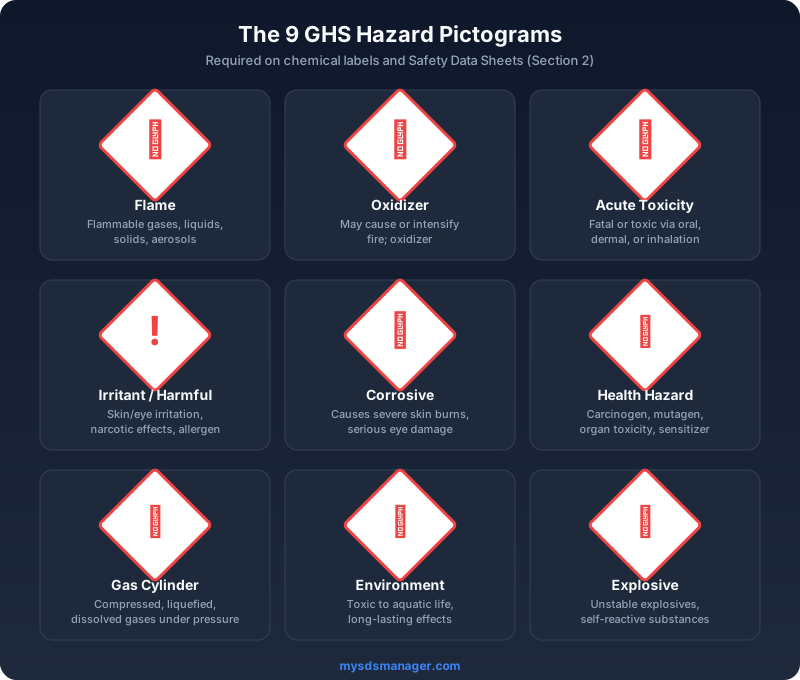
Before GHS labeling, chemical labels were — and I'm being generous here — a mess. One manufacturer used a skull icon for toxicity. Another used a red X. A third just wrote "harmful" in tiny print and called it a day. If you've ever stared at an unfamiliar chemical container trying to figure out whether it'll irritate your skin or dissolve it, you understand the problem. GHS fixed that with universal visual elements that mean the same thing whether you're in Toledo or Tokyo.
The 6 Required GHS Label Elements
| Element | Purpose | Example |
|---|---|---|
| Product Identifier | Chemical name matching the SDS | "Acetone" or "Product XR-200" |
| Signal Word | Severity indicator | "Danger" (severe) or "Warning" (less severe) |
| Hazard Statement(s) | Describes the nature of the hazard | "Highly flammable liquid and vapor" |
| Pictogram(s) | Visual hazard symbol | Red-bordered diamond with flame icon |
| Precautionary Statement(s) | Protective actions (prevention, response, storage, disposal) | "Keep away from heat, sparks, open flames" |
| Supplier Identification | Manufacturer name, address, phone | Company name + address + contact |
Understanding GHS Pictograms
GHS uses nine pictograms — red-bordered diamonds with black symbols on white backgrounds. Each pictogram represents specific hazard categories. A single product may display multiple pictograms if it presents multiple types of hazards.
The nine pictograms and their meanings:
- Flame — Flammable gases, liquids, solids, aerosols; self-heating substances; pyrophoric materials
- Flame Over Circle — Oxidizing gases, liquids, and solids
- Exploding Bomb — Explosives, self-reactive substances, organic peroxides
- Skull and Crossbones — Acute toxicity (fatal or toxic)
- Corrosion — Skin corrosion, serious eye damage, corrosive to metals
- Gas Cylinder — Gases under pressure (compressed, liquefied, dissolved)
- Exclamation Mark — Irritant, skin sensitizer, narcotic effects, respiratory tract irritation
- Health Hazard (person with star) — Carcinogenicity, mutagenicity, reproductive toxicity, organ toxicity
- Environment (dead tree and fish) — Hazardous to the aquatic environment
Signal Words: Danger vs. Warning
Every GHS label uses one signal word — never both. The signal word reflects the most severe hazard category on the label:
- Danger — Used for more severe hazard categories (e.g., acute toxicity Category 1-3, flammable liquid Category 1-2)
- Warning — Used for less severe hazard categories (e.g., acute toxicity Category 4, flammable liquid Category 4)
- No signal word — Some hazard categories don't require a signal word (e.g., flammable gas Category 2)
A product classified in both "Danger" and "Warning" categories only displays "Danger" — the more severe signal word takes precedence. Think of it like a traffic light: if any part of the product is red-level dangerous, the whole label says "Danger." You don't get a mixed signal.
Hazard and Precautionary Statements
Hazard statements describe what the chemical can do to you. Precautionary statements tell you what to do about it. Both use standardized phrases — manufacturers can't make up their own wording.
Hazard statements are coded with H-numbers (H220: "Extremely flammable gas"). Precautionary statements use P-numbers organized into four categories:
- Prevention (P200s) — Actions to minimize exposure ("Keep container tightly closed")
- Response (P300s) — What to do if exposure occurs ("IF IN EYES: Rinse cautiously with water")
- Storage (P400s) — Safe storage conditions ("Store in well-ventilated place")
- Disposal (P500s) — Safe disposal methods ("Dispose of contents/container in accordance with regulations")
Shipped Container Labels vs. Workplace Labels
GHS labels are required on shipped containers — the original packaging from the manufacturer. Workplace labels (also called secondary container labels) have different, less prescriptive requirements. For workplace labeling rules, see our guide on secondary container labeling.
The key distinction: shipped container labels must include all six GHS elements. Workplace labels must include the product identifier and words, pictures, symbols, or a combination that provides general information about the hazard. Many employers find it simplest to use the full GHS format for workplace labels too.
Label Durability and Readability
OSHA requires that labels remain legible and prominently displayed throughout the chemical's use. Practical requirements:
- Labels must withstand the conditions where the chemical is used — and if you've ever worked in a humid warehouse, you know how quickly paper labels turn to mush
- Faded, peeling, or damaged labels must be replaced immediately (not "when we get around to it")
- Labels must be in English; additional languages are permitted but not a substitute
- Print size must be readable at a reasonable distance
For a broader understanding of how GHS labels fit into your overall chemical safety program, check our OSHA HazCom Standard guide. Managing both labels and SDS together is easiest with a tool like MySDS Manager that ties each product's label information to its full SDS document.
Frequently Asked Questions
Are GHS labels required on all chemicals?
GHS labels are required on all hazardous chemicals shipped in the United States under OSHA's Hazard Communication Standard. Non-hazardous products, consumer products used as intended, pharmaceuticals, food, and cosmetics regulated by other agencies are exempt from GHS labeling requirements. If a product has a Safety Data Sheet, it needs a GHS-compliant label.
What's the penalty for non-compliant chemical labels?
Manufacturers who ship chemicals with non-compliant labels face OSHA citations up to $16,550 per serious violation. Employers who remove or deface incoming GHS labels, or fail to maintain label legibility, can also be cited. Each improperly labeled container can be a separate violation, so penalties can stack quickly across multiple products.
Can I create my own GHS labels?
Employers are not responsible for creating GHS labels on shipped containers — that's the manufacturer's obligation. However, if you transfer chemicals to secondary containers or need to replace damaged labels, you can create workplace labels. These must include the product identifier and hazard information. Using the full GHS format with all six elements is the safest approach for compliance.
Stop risking OSHA fines
MySDS Manager helps you organize your Safety Data Sheets digitally — scan a barcode, get the SDS instantly.
Start free — 10 products included