OSHA Hazard Communication Standard: Complete Guide

What Is the OSHA Hazard Communication Standard?
The OSHA Hazard Communication Standard (HazCom), codified at 29 CFR 1910.1200, requires employers to inform workers about hazardous chemicals in the workplace through container labeling, Safety Data Sheets, and training programs. Updated in 2012 to align with the Globally Harmonized System (GHS) — a United Nations framework for classifying and labeling chemicals — HazCom ensures consistent chemical hazard information across all U.S. workplaces.
Hazard Communication has been OSHA's most frequently cited standard for years — and that's not a coincidence. The standard touches every workplace that uses any hazardous chemicals. Cleaning supplies count. Spray paint counts. Even some office products count. And the requirements go deeper than most employers realize.
Here's the thing that catches people off guard: you don't need to be running a chemical plant. A yoga studio with cleaning products is technically covered. A coffee shop with oven cleaner? Covered. The bar is lower than most business owners think.
The Four Pillars of HazCom Compliance
HazCom compliance rests on four interconnected requirements. Missing any one of them can trigger citations.
| Pillar | What's Required | Who's Responsible |
|---|---|---|
| Written HazCom Program | Documented plan covering labels, SDS, and training | Employer |
| Safety Data Sheets | 16-section SDS for every hazardous chemical on site | Manufacturer creates; employer maintains |
| Container Labeling | GHS-compliant labels on shipped containers; workplace labels on secondary containers | Manufacturer (shipped); employer (secondary) |
| Employee Training | Initial and ongoing training on chemical hazards and protective measures | Employer |
Writing Your Hazard Communication Program
Every employer with hazardous chemicals needs a written HazCom program. Not a mental plan, not a verbal policy — a written document employees can reference. The program must be site-specific and include:
- Chemical inventory list — Every hazardous chemical used or stored at your workplace, updated as products change
- SDS management procedures — How you obtain, maintain, and provide employee access to Safety Data Sheets
- Labeling procedures — How incoming containers are checked for proper labels, how secondary containers are labeled
- Training procedures — When training occurs (new hire, new chemical, annual refresher), what's covered, who delivers it
- Non-routine tasks — How you handle chemical hazards during unusual operations (equipment maintenance, spill cleanup)
- Multi-employer workplace coordination — If contractors or other employers share your site, how hazard info is exchanged
This document doesn't need to be fancy. A clear, practical document that employees and OSHA inspectors can follow beats a polished manual nobody reads. I've reviewed programs that were 40 pages of copied boilerplate — an inspector will see right through that.
What a Good HazCom Program Looks Like
A solid HazCom program typically runs 3-10 pages, depending on your workplace complexity. Here's a practical structure: cover page with company name, address, program administrator, and revision date. A purpose statement and scope covering which locations and employee groups are included. Your chemical inventory — attached or referenced, updated quarterly. An SDS management section explaining where SDS are kept, who maintains them, and your backup access method. A labeling section with your shipped container inspection process, secondary labeling system, and responsible person. A training section with initial training timeline, refresher schedule, topics, and documentation method. And finally, non-routine task procedures and multi-employer coordination if applicable.
Safety Data Sheet Requirements Under HazCom
The HazCom standard requires employers to maintain a current SDS for every hazardous chemical in the workplace and ensure employees can access them during their shift. For a deep dive into SDS content and management, see our complete SDS guide.
Key SDS obligations under HazCom: obtain an SDS with the initial shipment of each hazardous chemical. Keep SDS readily accessible — not locked away or behind passwords employees don't have. Electronic storage is allowed if employees can access it immediately. Update SDS when manufacturers issue revised versions. Maintain SDS for the duration the chemical is used, plus 30 years of exposure records.
Managing this for dozens or hundreds of chemicals quickly becomes unmanageable with paper binders. Tools like MySDS Manager automate SDS collection, organization, and access — making compliance practical even for small teams.
GHS Labeling Requirements
The 2012 HazCom update adopted GHS labeling elements, creating a standardized label format for chemical products shipped in the U.S. Every shipped container must display:
A product identifier — the chemical name matching the SDS. A signal word — either "Danger" (more severe) or "Warning" (less severe). Hazard statements — standardized phrases describing each hazard. Pictograms — those red-bordered diamond symbols you've probably seen (there are 9 possible pictograms). Precautionary statements — prevention, response, storage, and disposal guidance. And supplier information — name, address, and phone number.
For complete details on what goes on a GHS label, check our GHS label requirements guide.
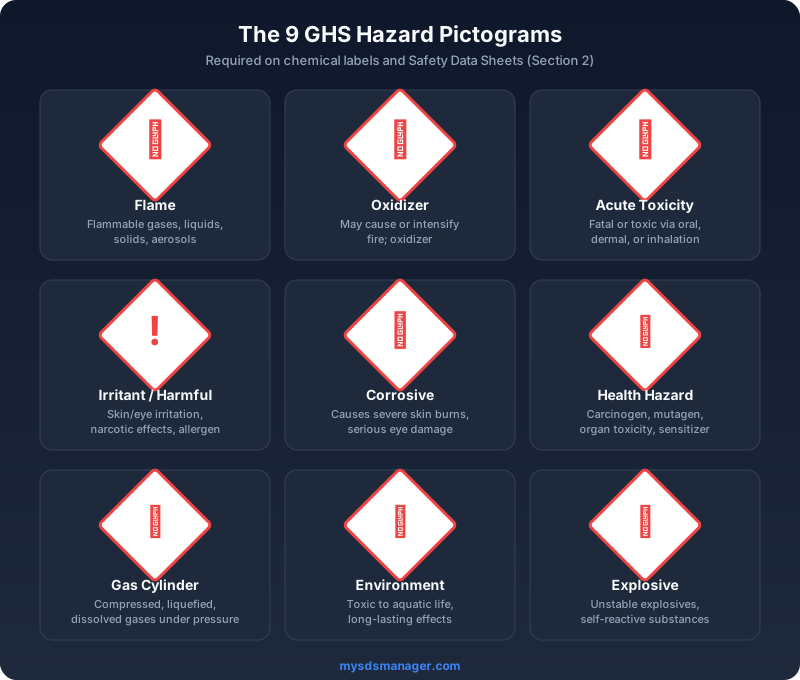
The 9 GHS Pictograms
GHS pictograms are the visual backbone of chemical hazard communication. Each red-bordered diamond conveys specific hazard categories:
| Pictogram Name | Hazards Covered | Common Examples |
|---|---|---|
| Flame | Flammable liquids, gases, aerosols, solids | Gasoline, acetone, propane |
| Flame Over Circle | Oxidizers | Hydrogen peroxide, bleach |
| Exploding Bomb | Explosives, self-reactive chemicals | TNT, certain organic peroxides |
| Skull and Crossbones | Acute toxicity (severe) | Cyanide compounds, methanol |
| Corrosion | Corrosive to metals, skin, eyes | Sulfuric acid, sodium hydroxide |
| Gas Cylinder | Gases under pressure | Compressed oxygen, nitrogen |
| Exclamation Mark | Irritant, narcotic, mild hazards | Many cleaning products |
| Health Hazard | Carcinogenicity, organ toxicity, mutagenicity | Benzene, formaldehyde |
| Environment | Aquatic toxicity | Pesticides, certain solvents |
Employee Training Requirements
Training is where most HazCom programs fall short. OSHA requires training at three points:
- Initial training — Before an employee works with or near any hazardous chemical for the first time
- New hazard training — Whenever a new chemical or new hazard is introduced to the workplace
- Refresher training — Not explicitly required by the standard, but strongly recommended annually and expected by OSHA inspectors
Training must cover: location and availability of the written HazCom program and SDS. Physical and health hazards of chemicals in the work area. How to read labels and Safety Data Sheets. How to detect the release or presence of a hazardous chemical (visual, odor, monitoring). And protective measures — PPE, work practices, emergency procedures.
Document every training session with dates, topics covered, attendee signatures, and trainer name. This documentation is your proof of compliance during an inspection. Without sign-in sheets and training outlines, OSHA treats the training as if it never happened.
Effective Training Strategies for Small Teams
You don't need a professional safety trainer to deliver effective HazCom training. Use the actual chemicals from your workplace as training props — way more engaging than slides. Walk employees through a real SDS for a product they use daily. Practice "find the answer" scenarios: "You spill Product X on your arm. Where do you look?" (Section 4.) Keep sessions under 30 minutes — shorter, focused sessions beat long lectures every time. And grab OSHA's free QuickCards and fact sheets as handouts.
HazCom for Multi-Employer Worksites
When multiple employers share a worksite — like construction sites or facilities using contractors — the host employer has additional obligations. Provide contractors with SDS for chemicals they may encounter on site. Inform contractors about labeling systems used at the facility. Share information about precautionary measures contractors' employees should follow. Coordinate emergency procedures between all employers on site.
The host employer should maintain a shared chemical inventory and designate a coordination contact. This prevents the nightmare scenario where a contractor unknowingly exposes their workers to hazards introduced by another employer.
Common HazCom Violations and How to Avoid Them
OSHA publishes the most-cited standards each year, and HazCom consistently ranks in the top 5. The most frequent violations:
No written program — Fix: create a site-specific written HazCom program today. It doesn't need to be perfect to start.
Incomplete chemical inventory — Fix: walk every area, including storage closets, maintenance rooms, and outdoor storage. Check under sinks. Open every cabinet.
Missing or outdated SDS — Fix: use digital SDS management to track and update automatically.
Unlabeled secondary containers — Fix: label every container that isn't the original shipped container. That spray bottle of degreaser your team refills? It needs a label.
Inadequate training records — Fix: document every training session with sign-in sheets and topic outlines.
Training gaps for new hires — Fix: include HazCom training in your onboarding checklist before any chemical exposure.
Frequently Asked Questions
Does HazCom apply to consumer products used in the workplace?
Consumer products are exempt from HazCom only when used in the same manner and quantity as a typical consumer. When a workplace uses products in greater quantities, more frequently, or for longer durations than normal consumer use, those products fall under HazCom requirements and need SDS and proper labeling. A bottle of Windex at a reception desk is likely exempt; cases of Windex for a janitorial crew are not.
How often must HazCom training be conducted?
OSHA requires initial training before first exposure to hazardous chemicals and additional training whenever new chemical hazards are introduced. While annual refresher training isn't explicitly mandated by the standard, OSHA expects employees to maintain working knowledge — making yearly refreshers a practical necessity and a best practice most safety professionals recommend.
What's the difference between HazCom 2012 and the original standard?
HazCom 2012 aligned the U.S. standard with the Globally Harmonized System (GHS), introducing standardized 16-section Safety Data Sheets, uniform label elements including pictograms and signal words, and consistent hazard classification criteria. The original standard allowed manufacturers to choose their own format, making it harder for workers to quickly find critical safety information across different products.
Stop risking OSHA fines
MySDS Manager helps you organize your Safety Data Sheets digitally — scan a barcode, get the SDS instantly.
Start free — 10 products included