The Complete Guide to Safety Data Sheets (SDS)

What Is a Safety Data Sheet?
A Safety Data Sheet (SDS) is a standardized document that provides detailed information about a chemical product's hazards, safe handling procedures, storage requirements, and emergency measures. Required under OSHA's Hazard Communication Standard (29 CFR 1910.1200), every workplace using hazardous chemicals must maintain accessible SDS documents for each product on site.
If you run a small business — auto shop, salon, cleaning company, manufacturing facility — you've dealt with chemical products. Bleach, solvents, adhesives, paints. Each one comes with risks your employees need to understand. That's where SDS documents come in.
Ever opened a chemical cabinet at work and realized you had no idea what half those bottles actually contained? You're not alone. Most small business owners I talk to underestimate their chemical inventory by at least 50%. The SDS is your cheat sheet for every product on your shelf.
Why Safety Data Sheets Matter for Your Business
SDS documents aren't just regulatory paperwork. They're a frontline safety tool. When an employee splashes a chemical in their eye, the SDS tells them exactly what to do. When a fire breaks out near stored chemicals, the SDS tells firefighters what they're dealing with.
Beyond safety, there's the compliance angle. OSHA can fine businesses up to $16,550 per serious violation for missing or inaccessible SDS documents. Willful or repeat violations? That jumps to $165,514. For a small business, that's potentially devastating. Read more about OSHA violation penalties and fine amounts.
There's also the liability side most people overlook. If an employee is injured by a chemical and your company didn't maintain the SDS, you're exposed to workers' compensation disputes, potential lawsuits, and significantly higher insurance premiums. I've seen a single incident without proper SDS documentation cost a shop owner more than ten years of compliance efforts would have.
| SDS Benefit | Safety Impact | Compliance Impact |
|---|---|---|
| Hazard identification | Employees know risks before handling | Meets HazCom training requirements |
| First aid procedures | Immediate response to exposure | Satisfies emergency planning |
| Storage guidelines | Prevents incompatible chemical mixing | Meets OSHA storage standards |
| PPE requirements | Correct protective gear for each chemical | Documents PPE compliance |
| Disposal methods | Prevents environmental contamination | Meets EPA disposal rules |
| Transport information | Safe shipping and receiving | Meets DOT transport requirements |
The 16 Sections of a Safety Data Sheet
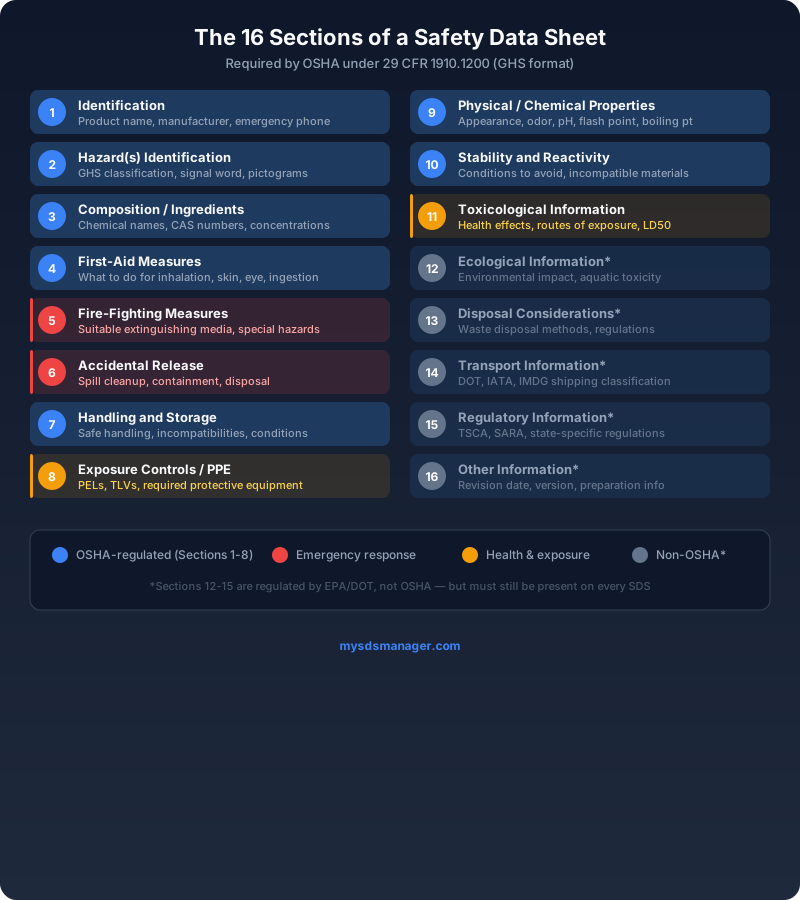
Every SDS follows a standardized 16-section format established by the Globally Harmonized System (GHS), a United Nations initiative adopted worldwide. This consistency means once you learn to read one SDS, you can read them all. Here's a breakdown of what each section covers — for a deep dive, check our guide on how to read all 16 SDS sections.
- Identification — Product name, manufacturer, recommended use, emergency phone number
- Hazard(s) Identification — GHS classification, signal words, hazard statements, pictograms
- Composition/Ingredients — Chemical ingredients and concentrations
- First-Aid Measures — Treatment for inhalation, skin contact, eye contact, ingestion
- Fire-Fighting Measures — Suitable extinguishing media, special hazards, firefighter equipment
- Accidental Release Measures — Spill cleanup procedures, containment methods
- Handling and Storage — Safe handling practices, incompatible materials, storage conditions
- Exposure Controls/PPE — Permissible exposure limits, engineering controls, personal protective equipment
- Physical and Chemical Properties — Appearance, odor, pH, flash point, boiling point
- Stability and Reactivity — Chemical stability, conditions to avoid, incompatible materials
- Toxicological Information — Routes of exposure, symptoms, acute and chronic effects
- Ecological Information — Environmental toxicity, persistence, bioaccumulation
- Disposal Considerations — Waste treatment methods, contaminated packaging disposal
- Transport Information — UN number, shipping name, transport hazard class
- Regulatory Information — National regulations specific to the product
- Other Information — Date of preparation, revision date, version number
Who Needs to Maintain SDS Documents?
Short answer: any employer whose workers may be exposed to hazardous chemicals. And that covers far more businesses than most people realize.
OSHA's Hazard Communication Standard applies to every industry where employees handle or could be exposed to chemicals. That includes:
Manufacturing and industrial facilities. Construction companies. Auto repair shops and body shops. Hair salons and spas — yes, hair dye, nail chemicals, and cleaning agents all count. Cleaning and janitorial services. Restaurants handling cleaning chemicals, degreasers, and cooking oils. Healthcare facilities using disinfectants, sterilizing agents, and lab chemicals. Retail stores selling chemicals. Schools and universities with labs. Landscaping companies working with herbicides, pesticides, and fuel.
Even a small office isn't exempt if employees use products like toner, cleaning sprays, or hand sanitizer in bulk quantities. Honestly, most business owners I've worked with are surprised when they find out their break room cleaning supplies need SDS coverage.
How to Organize and Manage Your SDS Collection
OSHA requires that SDS documents be "readily accessible" to employees during their work shift. The old way — binders stuffed with paper sheets — technically meets the requirement, but it creates real problems. Sheets go missing. Binders end up locked in a manager's office. Updates get lost.
The Traditional Binder Approach
Physical SDS binders work for very small operations with fewer than 10 chemical products. You print each SDS, organize alphabetically or by work area, and place the binder where employees can grab it. The downside: you're responsible for manually checking manufacturer websites for updated versions, reprinting, and swapping pages. Most small businesses that rely on binders fall behind on updates within the first year. It's just human nature — nobody remembers to check for a revised SDS on a Tuesday afternoon.
Digital SDS Management
Most businesses with more than a handful of chemicals benefit from digital SDS management. A tool like MySDS Manager lets you upload, organize, search, and share SDS documents from any device. Employees pull up the right SDS on a phone or tablet in seconds — no digging through binders.
Digital systems also handle version control automatically, flag outdated documents, and generate compliance reports when OSHA comes knocking. For businesses with multiple locations, digital management means every site has instant access to the same up-to-date SDS library.
Paper vs. Digital SDS Management
| Feature | Paper Binders | Digital SDS Software |
|---|---|---|
| Search speed | Minutes (flipping pages) | Seconds (keyword search) |
| Accessibility | Fixed location only | Any device, anywhere |
| Version updates | Manual reprinting | Automatic alerts |
| OSHA audit readiness | Depends on organization | One-click reports |
| Cost for 50+ chemicals | Low upfront, high labor | Low monthly fee, minimal labor |
| Multi-location access | Separate binder per location | Single library, all locations |
| Backup/disaster recovery | Vulnerable to fire, water damage | Cloud-backed, always available |
SDS vs. MSDS: What Changed?
Before 2012, these documents were called Material Safety Data Sheets (MSDS). The format varied wildly between manufacturers — some had 8 sections, others had 20, and the order was inconsistent. GHS alignment changed all that, creating the standardized 16-section SDS format used today. If you still have MSDS documents in your files, they're outdated and non-compliant. For the full story on the transition, see our article on SDS vs. MSDS differences.
OSHA Requirements for SDS
Under 29 CFR 1910.1200 (the Hazard Communication Standard), employers must:
- Maintain an SDS for every hazardous chemical in the workplace
- Ensure SDS documents are readily accessible to employees during work shifts
- Train employees on how to read and use SDS documents
- Include SDS management in the written Hazard Communication Program
- Update SDS when manufacturers issue revised versions
- Retain SDS records for chemicals that are no longer in use (required under exposure records retention, 29 CFR 1910.1020)
There's no requirement to keep SDS documents for non-hazardous consumer products used in the same manner and quantity as a typical consumer would. But when in doubt, keep the SDS — it's better to have it and not need it.
Common SDS Mistakes Small Businesses Make
After working with hundreds of small businesses, certain patterns emerge. These are the mistakes that lead to OSHA citations most often.
Missing SDS for "common" chemicals. Bleach, WD-40, and spray paint all need SDS documents. Just because you can buy it at Home Depot doesn't mean it's exempt.
Outdated versions. Manufacturers update SDS regularly; you need the current version. A 2019 sheet for a product reformulated in 2023 won't fly during an inspection.
Inaccessible storage. Locked offices or password-protected computers employees can't access. If your night shift can't get to the SDS without calling a manager, you've got a problem.
No employee training. Having the SDS isn't enough; employees must know how to use them. Can your team actually find Section 4 in an emergency? Most can't without training.
Incomplete chemical inventory. Forgetting about chemicals in janitorial closets or maintenance areas. Do a proper walkthrough — you'll be surprised what turns up.
No backup access method. If your SDS are digital-only and the internet goes down, you need a backup plan.
Thinking "we only have a few chemicals." Most businesses undercount by 50% or more when they do a proper walkthrough. A restaurant owner once told me they had "maybe 5 chemicals." We counted 37.
Getting Started with SDS Management
Whether you have 5 chemicals or 500, the process starts the same way:
- Walk through every area of your facility and list every chemical product — don't skip break rooms, bathrooms, storage closets, or outdoor areas
- Collect the current SDS for each product (check manufacturer websites or use MySDS Manager to find them — see our guide on where to find Safety Data Sheets)
- Organize your SDS by work area or alphabetically
- Make them accessible — digitally or in clearly labeled binders at each work station
- Train employees on where to find SDS and how to read key sections (focus on Sections 2, 4, 7, and 8)
- Set a quarterly reminder to check for updated versions
- Document everything — your chemical inventory, training dates, SDS updates — so you're ready when OSHA asks
Frequently Asked Questions
How long do you have to keep Safety Data Sheets?
OSHA requires employers to keep SDS documents accessible for as long as the chemical is used in the workplace. Additionally, under 29 CFR 1910.1020, you must retain records of chemical exposures for 30 years after an employee leaves. Keep old SDS versions on file even after switching products — they document what employees were exposed to during their employment.
Can SDS documents be stored electronically?
Yes. OSHA explicitly allows electronic SDS storage as long as employees can access them immediately during their shift without barriers. The system must work reliably — if your internet goes down, you need a backup method like downloaded offline copies or printed emergency binders. Employees must also be trained on how to use the electronic system.
Who is responsible for creating a Safety Data Sheet?
The chemical manufacturer, importer, or distributor is responsible for creating and distributing SDS documents. Employers are not required to write SDS — they're required to obtain them, maintain them, and ensure employee access. If a supplier doesn't provide an SDS, request one in writing and document your request.
What happens if you don't have SDS on site?
Missing SDS documents can result in OSHA citations under the Hazard Communication Standard. Serious violations carry fines up to $16,550 per instance. Beyond fines, lacking SDS puts employees at risk — without hazard information, they can't protect themselves during handling or emergencies. Each missing SDS can be a separate violation, so costs escalate quickly.
Stop risking OSHA fines
MySDS Manager helps you organize your Safety Data Sheets digitally — scan a barcode, get the SDS instantly.
Start free — 10 products included