How to Read a Safety Data Sheet: All 16 Sections Explained

How Do You Read a Safety Data Sheet?
Reading a Safety Data Sheet means knowing which of the 16 standardized sections has what you need. For day-to-day use, focus on Section 2 (hazard identification), Section 4 (first aid), Section 7 (handling and storage), and Section 8 (PPE requirements). Every SDS follows the same GHS order, so once you learn the layout, you can navigate any chemical product's SDS in seconds.
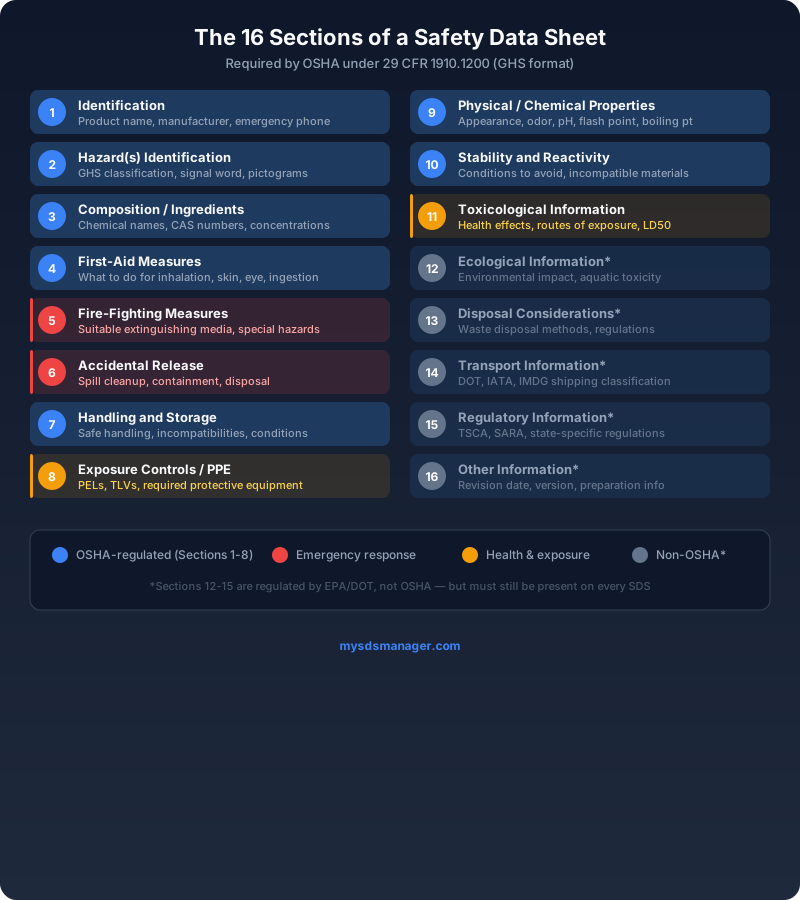
Here's the reality: most employees never read an SDS cover to cover. And honestly? They don't need to. What matters is knowing where to look when it counts. Chemical splashes on your skin? Section 4. Need to know what gloves to wear before opening that new solvent? Section 8. Figuring out where to store a product that just arrived? Section 7. It's a reference document, not a novel.
The Sections That Matter Most Day-to-Day
Not all 16 sections carry equal weight for daily safety. Here's how to prioritize:
| Priority | Section | When You Need It |
|---|---|---|
| Critical | Section 2: Hazard Identification | Before first use — know what you're dealing with |
| Critical | Section 4: First-Aid Measures | During any exposure incident |
| Critical | Section 8: Exposure Controls/PPE | Before handling — know what protection to use |
| Important | Section 5: Fire-Fighting Measures | Emergency planning, fire response |
| Important | Section 6: Accidental Release | Spill response |
| Important | Section 7: Handling and Storage | Setting up storage areas, daily handling |
| Reference | Sections 1, 3, 9-16 | Specific questions, compliance documentation |
All 16 Sections Explained
Section 1: Identification
Lists the product name, manufacturer contact information, recommended uses, and the emergency phone number. Quick tip: always verify this matches the product you're actually using. Different formulations of the same brand can have completely different hazard profiles and separate SDS documents.
Section 2: Hazard Identification
The most important section for quick hazard assessment. Contains GHS classification, signal word (Danger or Warning), hazard statements, pictograms, and precautionary statements. Read this before using any new chemical product for the first time. No exceptions.
Section 3: Composition/Ingredients
Lists chemical ingredients with CAS numbers and concentration ranges. Useful when checking for specific allergens, restricted substances, or comparing products. Trade secret ingredients may be withheld — but must be disclosed in medical emergencies.
Section 4: First-Aid Measures
Covers treatment for four exposure routes: inhalation, skin contact, eye contact, and ingestion. This is the section you want posted near work areas where the chemical is used. During an emergency, this is what paramedics and poison control need — not the marketing brochure.
Section 5: Fire-Fighting Measures
Specifies suitable and unsuitable extinguishing media, special fire hazards, and equipment for firefighters. Some chemicals react violently with water — this section tells you whether a water extinguisher will help or make things dramatically worse.
Section 6: Accidental Release Measures
Spill cleanup procedures, containment methods, and personal precautions. Covers small spills (what your employees can handle) and large spills (when to evacuate and call the professionals).
Section 7: Handling and Storage
Safe handling practices, incompatible materials to keep separated, and storage conditions — temperature, ventilation, container requirements. Critical for setting up storage areas correctly the first time.
Section 8: Exposure Controls/Personal Protection
Lists occupational exposure limits (PEL, TLV), engineering controls needed, and specific PPE requirements — glove type, eye protection, respiratory protection. This section tells you exactly what protective gear employees need. Not "some gloves" — the specific type and material.
Section 9: Physical and Chemical Properties
Appearance, odor, pH, flash point, boiling point, vapor pressure, and other physical characteristics. The flash point is particularly critical for flammable materials — it's the temperature at which vapors can ignite.
Section 10: Stability and Reactivity
Whether the chemical is stable, what conditions trigger dangerous reactions, and which materials are incompatible. Always check this before storing chemicals near other products.
Section 11: Toxicological Information
Detailed toxicity data, exposure routes, symptoms of overexposure, and both acute and chronic health effects. Medical professionals use this section to assess exposure severity.
Sections 12-16: Regulatory and Environmental
These cover ecological impact (12), disposal requirements (13), transport regulations (14), national regulations (15), and revision history (16). Sections 12-15 are informational — OSHA doesn't enforce their content, but EPA and DOT regulations referenced in them absolutely do apply.
Quick-Reference Reading Strategy
New chemical product just showed up at your facility? Don't wing it. Follow this reading order:
- Section 2 — Identify all hazards and pictograms
- Section 8 — Determine required PPE before anyone touches it
- Section 7 — Set up proper storage before cracking open the container
- Section 4 — Brief employees on first-aid measures
- Section 1 — Save the emergency phone number where people can actually find it
For a broader overview of SDS requirements and management, see our complete SDS guide. If you're managing multiple products, a digital tool like MySDS Manager makes it easy to search specific sections across your entire SDS library — no binder-flipping required.
Tips for Employee SDS Training
Reading an SDS shouldn't feel like cramming for an exam. Make it practical:
- Use SDS documents for chemicals your employees actually handle daily — not hypothetical examples
- Run "find the answer" drills — give a scenario ("someone spilled this on their arm"), have employees race to find the right section
- Post Section 4 (first aid) summaries at workstations where the chemical is used
- Focus training on Sections 2, 4, 7, and 8 — the four sections that matter for daily safety
- Show employees how to pull up SDS on their phones — because they won't walk to the back office during an emergency
For related OSHA requirements around chemical safety, check out our guide on the HazCom standard.
Frequently Asked Questions
Which SDS section has first aid information?
Section 4: First-Aid Measures. It covers treatment for inhalation, skin contact, eye contact, and ingestion. It also lists the most important symptoms and effects of exposure, plus any immediate medical attention or special treatment needed. Post Section 4 summaries near chemical work areas — that's where they'll actually get used.
Do all SDS documents look the same?
Same structure, different visual design. All SDS follow the same 16-section order as required by GHS and OSHA's HazCom 2012 standard. But fonts, colors, and page layout vary between manufacturers. The important thing is that the information is always in the same section number, so you can find it regardless of who made the product.
How long is a typical Safety Data Sheet?
Most run between 6 and 16 pages, depending on the chemical's complexity and number of hazards. Simple single-ingredient products tend to be shorter, while complex mixtures with multiple hazards can exceed 20 pages. Every SDS includes all 16 sections even if some contain minimal information.
Stop risking OSHA fines
MySDS Manager helps you organize your Safety Data Sheets digitally — scan a barcode, get the SDS instantly.
Start free — 10 products included