OSHA Compliance Guide for Small Businesses

What Does OSHA Compliance Mean for Small Businesses?
OSHA compliance means meeting the workplace safety standards set by the Occupational Safety and Health Administration. For small businesses, this includes maintaining proper hazard communication, providing safety training, keeping injury records, displaying required posters, and ensuring a safe physical work environment — all scaled to your specific industry and workforce size.
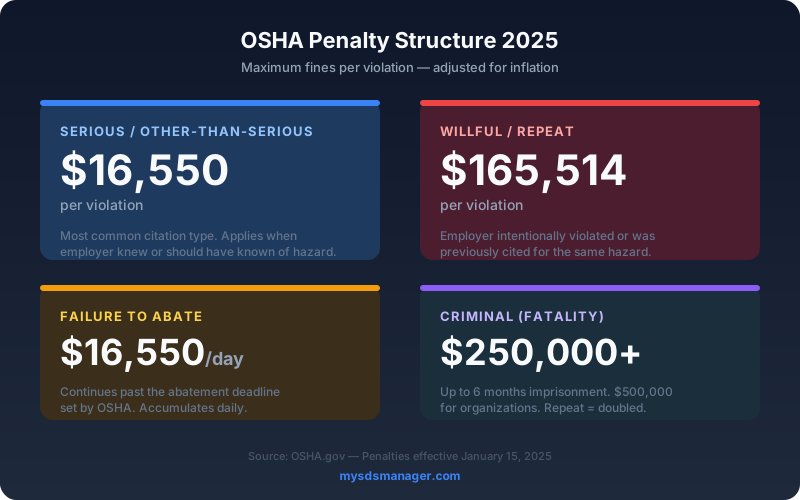
Running a small business means wearing a dozen hats. Safety compliance? It usually falls somewhere between "I'll get to it next week" and "wait, that was required?" But here's the thing — OSHA doesn't grade on a curve for business size. A 5-person auto shop faces the same standards as a 500-employee factory — the rules just apply differently based on your industry hazards.
Does OSHA Apply to My Business?
Almost certainly yes. OSHA covers most private-sector employers in the United States, regardless of size. There are very limited exemptions:
| Business Type | OSHA Coverage | Notes |
|---|---|---|
| Private employer, 1+ employees | Fully covered | All general industry and construction standards apply |
| Self-employed (no employees) | Not covered | OSHA only regulates employers with employees |
| 10 or fewer employees (certain industries) | Covered, but exempt from some recordkeeping | Still must comply with all safety standards |
| Federal government agencies | Covered under Executive Order | Different enforcement mechanism |
| State/local government | Only in states with OSHA-approved state plans | 26 states have state plans |
The "10 or fewer employees" exemption only applies to OSHA recordkeeping (Form 300 logs) — not to actual safety standards. You still need SDS documents, proper labels, training, and safe working conditions.
Core OSHA Requirements Every Small Business Must Meet
1. Hazard Communication Program
If your workplace has any hazardous chemicals — and nearly all do — you need a written Hazard Communication (HazCom) program. This covers everything from cleaning supplies to lubricants. Your program must include a chemical inventory, Safety Data Sheets for every product, proper container labeling, and employee training. Learn the full standard in our OSHA HazCom Standard guide.
2. OSHA Poster Display
Every employer must display the "Job Safety and Health — It's the Law" poster where employees can see it. This is one of the most common violations because it seems too simple to matter. It does matter. Learn exactly what's required in our OSHA poster requirements guide.
3. Injury and Illness Recordkeeping
Most employers with more than 10 employees must maintain OSHA 300 logs recording workplace injuries and illnesses. Certain high-hazard industries must keep these records regardless of size. Every employer, regardless of size, must report:
- Fatalities — within 8 hours
- Hospitalizations, amputations, or eye loss — within 24 hours
4. Safety Training
OSHA requires training whenever employees face workplace hazards. The specific training depends on your industry, but common requirements include:
- Hazard Communication training (chemical safety, SDS reading)
- Fire extinguisher training (if employees are expected to use them)
- Emergency action plan training
- PPE training (selection, use, maintenance)
- Industry-specific training (forklift, confined space, fall protection, etc.)
5. Personal Protective Equipment (PPE)
When engineering controls can't eliminate hazards, employers must provide appropriate PPE at no cost to employees. This includes gloves, eye protection, hearing protection, respirators, and any other equipment needed for safe work. You must also train employees on proper PPE use and maintain records of the PPE hazard assessment.
6. Emergency Action Plan
Employers with more than 10 employees must have a written emergency action plan. Smaller employers can communicate it verbally, but a written plan is always better. The plan must cover evacuation procedures, reporting procedures, alarm systems, and emergency escape routes. Post evacuation maps and conduct drills at least annually.
The 5 Most Common OSHA Violations for Small Businesses
Year after year, the same violations dominate OSHA's citation list. Small businesses get hit particularly hard because they often lack dedicated safety staff.
| Violation | OSHA Standard | Typical Fine Range |
|---|---|---|
| Hazard Communication deficiencies | 1910.1200 | $4,000 - $16,550 |
| Missing or outdated SDS | 1910.1200(g) | $4,000 - $16,550 |
| Lack of fall protection | 1926.501 | $4,000 - $16,550 |
| Inadequate machine guarding | 1910.212 | $4,000 - $16,550 |
| No respiratory protection program | 1910.134 | $4,000 - $16,550 |
For a detailed breakdown of fines and how they're calculated, see our article on OSHA violation penalties.
Step-by-Step: Building Your OSHA Compliance Program
Don't try to tackle everything at once. Start with the highest-risk areas and build from there.
- Conduct a workplace hazard assessment — Walk through your facility. Identify chemical, physical, biological, and ergonomic hazards in each area. Take photos and notes.
- Build your chemical inventory — List every hazardous chemical product. Don't skip bathrooms, break rooms, maintenance closets, or outdoor storage.
- Write your HazCom program — Document your labeling system, SDS management process, and training procedures.
- Set up SDS management — Organize your SDS digitally using a tool like MySDS Manager so employees can access them instantly from any device.
- Train your employees — Cover hazard identification, SDS reading, PPE use, and emergency procedures. Document everything with sign-in sheets and training outlines.
- Display required posters — Get the free OSHA poster and put it where everyone can see it.
- Set up recordkeeping — If required, create your OSHA 300 log system for injury/illness tracking.
- Create an emergency action plan — Document evacuation routes, emergency contacts, and response procedures. Post maps near exits.
- Schedule regular reviews — Quarterly self-inspections catch problems before OSHA does. Use a simple checklist and walk the same route each time.
Free OSHA Resources for Small Businesses
OSHA actually offers substantial free help for small businesses. Most owners don't know these exist:
- On-Site Consultation Program — Free, confidential safety assessments. OSHA sends consultants to your workplace — no citations, no penalties. Available in every state through state-run programs.
- OSHA.gov publications — Industry-specific guidance documents, fact sheets, and QuickCards covering common hazards
- Susan Harwood Training Grants — Free safety training programs for workers in high-hazard industries
- Small Business Handbook — OSHA Publication 2209, a plain-language compliance guide available for download
- eTools and Expert Advisors — Interactive online tools that walk you through specific standards
The On-Site Consultation Program deserves special mention — and frankly, it's one of the best-kept secrets in small business safety. It's completely separate from OSHA enforcement. Consultants visit your site, identify hazards, suggest fixes, and help you build a compliance program — all without the risk of citations. Over 30,000 small businesses use this program annually. I've seen shop owners go from dreading the word "OSHA" to feeling genuinely confident about their safety setup after a single consultation visit. The only catch: you must agree to correct any serious hazards identified during the visit.
What Happens During an OSHA Inspection?
OSHA inspections can be triggered by employee complaints, severe injuries, referrals, or random selection (targeted by industry risk). Here's the typical flow:
- Compliance officer arrives and presents credentials — verify them by calling your local OSHA office
- Opening conference explains the inspection scope and reason for the visit
- Walkaround inspection of the workplace (you have the right to accompany the inspector)
- Document review — injury logs, training records, SDS, written programs
- Employee interviews (private, you cannot be present or retaliate)
- Closing conference summarizes findings and potential citations
- Citations mailed within 6 months if violations are found
Should you demand a warrant? You have the legal right to, but this usually just delays the process and doesn't prevent the inspection. Cooperating professionally and having organized records makes the process smoother and often results in lower penalties.
Industry-Specific Considerations
While the core requirements apply broadly, certain industries face additional OSHA standards:
- Construction — Fall protection (1926.501), scaffolding (1926.451), trenching (1926.652)
- Manufacturing — Machine guarding (1910.212), lockout/tagout (1910.147), electrical (1910.303-399)
- Auto repair — Hazard communication, respiratory protection, fire safety, lift safety
- Restaurants — Chemical safety (degreasers, sanitizers), slip/fall prevention, fire suppression
- Healthcare — Bloodborne pathogens (1910.1030), hazardous drugs, ergonomics
Check OSHA's website for your specific NAICS code to see which standards apply to your industry.
Frequently Asked Questions
Is OSHA compliance mandatory for businesses with fewer than 10 employees?
Yes. Businesses with fewer than 10 employees must comply with all OSHA safety and health standards. The only exemption is from routine recordkeeping (OSHA 300 logs) for certain low-hazard industries. You still must report fatalities within 8 hours and hospitalizations within 24 hours, regardless of your employee count or industry classification.
How much does OSHA compliance cost a small business?
Basic compliance costs vary widely by industry, but most small businesses spend between $500 and $5,000 annually on safety training, PPE, and compliance tools. That's a fraction of what a single OSHA violation fine costs — up to $16,550 for a serious violation. Free consultation programs and affordable SDS management tools like MySDS Manager help keep costs manageable.
Can I handle OSHA compliance myself or do I need a consultant?
Many small business owners successfully manage OSHA compliance without outside help, especially with OSHA's free resources and digital tools. Start with OSHA's free On-Site Consultation Program for an expert assessment. For ongoing management, digital SDS tools and basic safety training programs cover most general industry requirements without needing a dedicated safety professional.
Stop risking OSHA fines
MySDS Manager helps you organize your Safety Data Sheets digitally — scan a barcode, get the SDS instantly.
Start free — 10 products included