SDS Pictograms: What Every Symbol Means (With Descriptions)

You've seen those red-bordered diamonds on chemical labels and Safety Data Sheets. But do you actually know what each one means? I once watched a warehouse supervisor confidently point to the health hazard pictogram and call it "the explosion one." He'd been handling chemicals for eight years. If you're responsible for hazcom compliance, you need to know these cold — and so does every employee who handles chemicals.
What Are SDS Pictograms?
SDS pictograms are standardized symbols from the Globally Harmonized System (GHS) that appear in Section 2 of every Safety Data Sheet. There are nine pictograms in total, each representing a specific category of hazard — from flammability to acute toxicity. OSHA adopted these symbols through HazCom 2012 to standardize chemical hazard communication. Unlike the older NFPA 704 diamond system (which is still used on fixed storage and buildings), GHS pictograms appear on container labels and Safety Data Sheets — making hazards instantly recognizable across borders and languages.
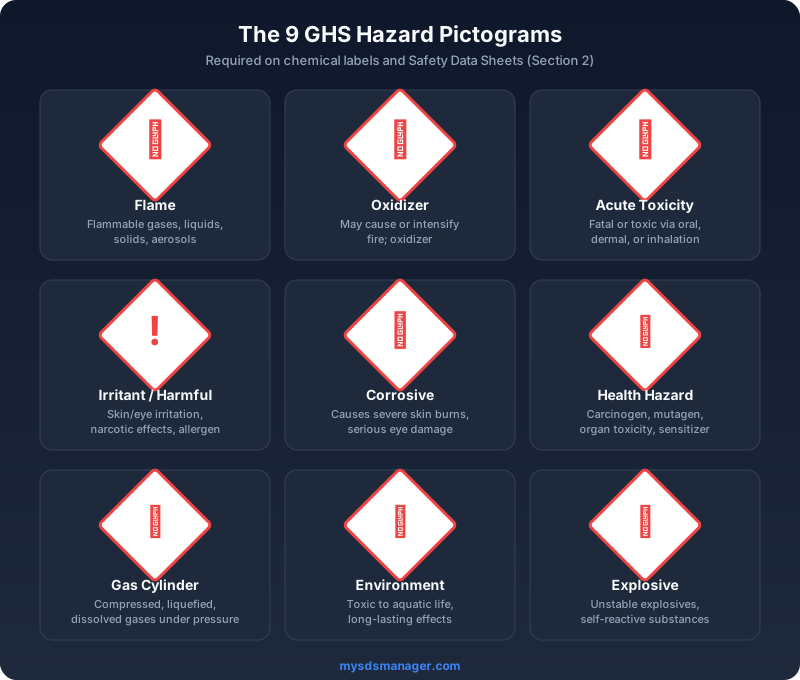
All 9 GHS Pictograms Explained
Here's a breakdown of what each symbol means and where you'll typically encounter it in a workplace setting.
| Pictogram Name | Hazard Type | Common Examples |
|---|---|---|
| Flame | Flammable liquids, gases, aerosols | Acetone, ethanol, propane |
| Flame Over Circle | Oxidizers that intensify fire | Hydrogen peroxide, potassium permanganate |
| Exploding Bomb | Explosives, self-reactive chemicals | Nitroglycerin, organic peroxides |
| Skull and Crossbones | Acute toxicity (fatal/toxic) | Methanol, hydrogen cyanide |
| Corrosion | Skin corrosion, metal corrosion | Sulfuric acid, sodium hydroxide |
| Exclamation Mark | Irritation, narcotic effects, mild hazards | Many cleaning products |
| Health Hazard | Carcinogenicity, organ damage, mutagenicity | Benzene, formaldehyde |
| Gas Cylinder | Gases under pressure | Compressed nitrogen, CO2 tanks |
| Environment | Aquatic toxicity | Certain pesticides, heavy metals |
How Pictograms Appear on an SDS
Pictograms show up in Section 2: Hazards Identification of the SDS. They're printed alongside signal words ("Danger" or "Warning"), hazard statements, and precautionary statements. A single product can display multiple pictograms — a solvent like toluene, for instance, carries the flame, exclamation mark, and health hazard symbols simultaneously.
When reviewing an SDS, don't stop at the pictograms. Cross-reference them with the hazard statements in the same section for specific exposure routes and severity levels.
Why Pictogram Training Matters
- Instant hazard recognition — Workers identify risks before reading the full SDS, which matters during spills or emergencies.
- OSHA compliance — The HazCom 2012 standard requires employers to train workers on GHS pictograms. Fines for non-compliance start at $16,550 per serious violation (up to $165,514 for willful violations). Worth the gamble?
- Cross-language communication — Symbols transcend language barriers, which is critical in multilingual workplaces.
- Proper PPE selection — The corrosion pictogram tells you gloves and goggles are likely needed; the skull and crossbones demands respiratory protection.
Common Pictogram Mistakes to Avoid
The biggest error I see? Confusing the exclamation mark with the health hazard symbol. They look nothing alike, but people mix up their meanings constantly. The exclamation mark covers irritation and mild effects. The health hazard silhouette — that starburst-on-chest icon — signals serious chronic effects like cancer or organ damage. Mixing these up can lead to dangerously inadequate PPE.
Another frequent mistake: assuming the environment pictogram (dead fish and tree) is optional. While OSHA doesn't enforce it for workplace labels, it's mandatory on SDS documents and shipping labels under GHS rules.
Connecting Pictograms to Your Safety Data Sheet System
Every pictogram on a label should match what's documented in Section 2 of the corresponding SDS. If they don't match, that's a red flag — either the label is outdated or the SDS needs updating. Keeping your SDS binder current ensures this alignment stays intact.
FAQ
How many GHS pictograms exist?
There are nine GHS pictograms, each representing a distinct hazard category. All nine can appear on Safety Data Sheets, though OSHA only requires eight on workplace labels (the environment pictogram is excluded from OSHA's HazCom standard).
Can a chemical have more than one pictogram?
Yes, and most do. A product like isopropyl alcohol carries both the flame and exclamation mark pictograms. Some industrial chemicals display four or five symbols simultaneously.
Do pictograms replace the old NFPA diamond system?
Not exactly. OSHA's HazCom 2012 standard uses GHS pictograms for labels and SDS documents. However, NFPA 704 diamonds are still used on fixed storage tanks and buildings — they serve different purposes and can coexist.
Stop risking OSHA fines
MySDS Manager helps you organize your Safety Data Sheets digitally — scan a barcode, get the SDS instantly.
Start free — 10 products included